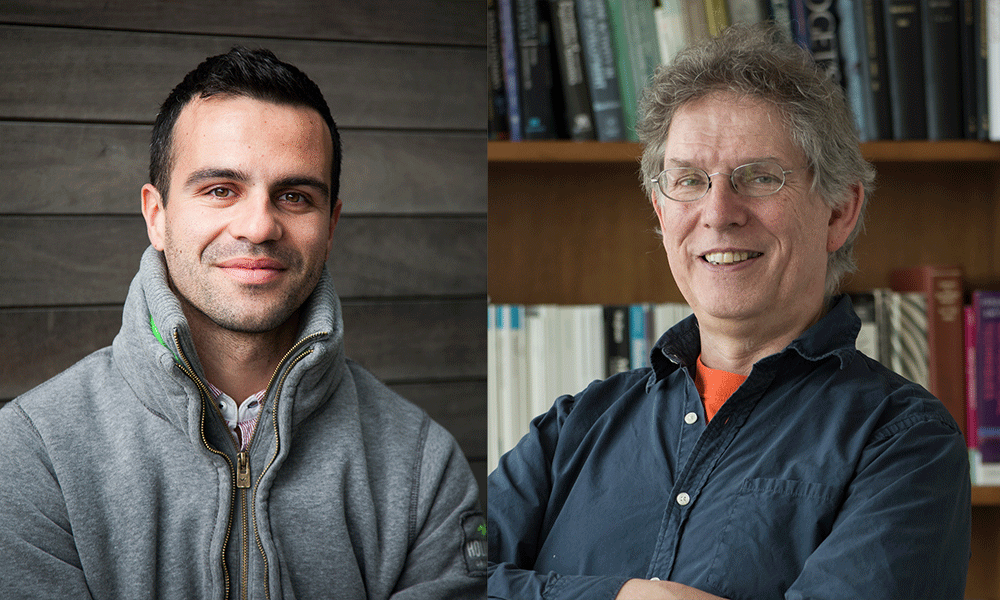
A recent collaboration between the Murray Lab and the Nelson Lab found that microbial antagonism can mirror the formation and dissipation of beer bubbles. The study, led by…
100 Years Biochemical Sciences Tutorial


A recent collaboration between the Murray Lab and the Nelson Lab found that microbial antagonism can mirror the formation and dissipation of beer bubbles. The study, led by…
Evolutionary adaptation is the process by which organisms change or acquire features over time in response to new challenges. The ability of organisms to adapt is remarkable and…


MCB faculty Andrew Murray is one of the five professors from across FAS to be named a 2021 Harvard College Professor. The Harvard College Professorships are five-year appointments…
Postdoc María Angélica Bravo Núñez of the Murray Lab was recently named as a 2021 Hanna H. Gray Fellow, a high-profile award from HHMI that funds exceptionally promising…


Each year, the American Physical Society (APS) Division of Fluid Dynamics holds a video and poster contest, celebrating 2-3 minute videos that communicate concepts in biophysics and fluid…
As a graduate student, more than thirty years ago, I enjoyed doing experiments so much that I would go into lab on Sunday mornings secure in the knowledge…


Molecular machines underlie the vast diversity of the living world and are the result of millions of years of selection to optimize them for particular biochemical tasks. If…
Fumasoni and Murray show how evolution can quickly and reproducibly change conserved features involved in the maintenance of genomes in response to constitutive problems affecting DNA replication. Four…


Biological function, such as DNA replication and chromosome segregation, depend on the complex interactions among many different proteins. As a biological function changes during evolution, the network of…
We have discovered that cancer might arise faster than previously thought: by combining evolution of yeast cells and human cell culture experiments Miguel Coelho and Andrew Murray were…