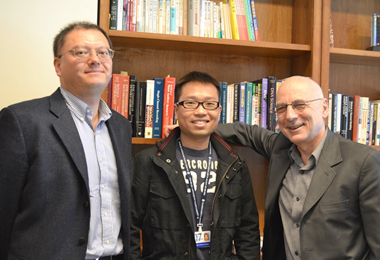
(l to r) Alex Schier, Andi Pauli, Megan Norris, Eivind Valen, and Guo-Liang Chew According to the British embryologist Lewis Wolpert, “it is not birth, marriage, or death,…

100 Years Biochemical Sciences Tutorial


(l to r) Alex Schier, Andi Pauli, Megan Norris, Eivind Valen, and Guo-Liang Chew According to the British embryologist Lewis Wolpert, “it is not birth, marriage, or death,…
(l to r) Anna Puszynska, Joseph Piechura, and Erin O'Shea (not shown Joseph Markson) Organisms from humans to bacteria utilize endogenous timing mechanisms called circadian clocks to coordinate…


(l to r) Andrew Murray and Lori Huberman What makes a sex? There are two answers to this question, the master regulators that tell organisms which sex they…
Bacillus subtilis is a bacterium with many talents. Some cells devote themselves to exploration, abandoning their relatives to live as swimming ‘motile’ cells. Others instead choose a cooperative,…
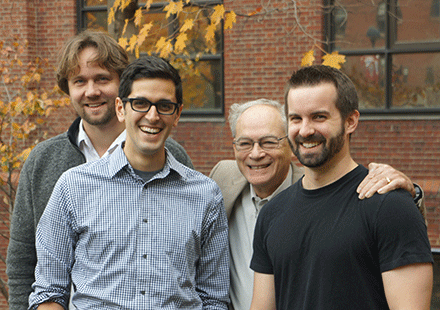

(l to r) Carl Wu, Vu Nguyen, Debbie Wei, Anand Ranjan, and Andres Leschziner Genome packaging is a universal process in eukaryotes. In the smallest repeating unit of…
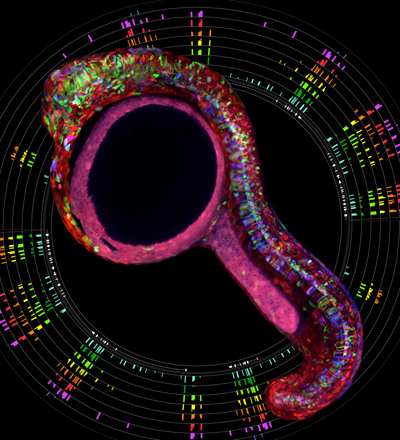
A Zebrabow fish circled by a rainbow of ribosome profiles. In three papers published in Development, the Schier lab suggests that signals move through developing tissues by hindered…

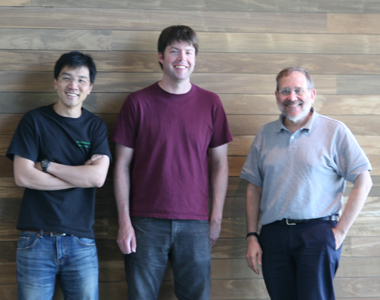
(l to r) Howard Berg, Pushkar Lele, and Basarab Hosu Contact with a surface is believed to trigger bacterial swarmer-cell differentiation, and the flagellar motor is thought to…
Neurons send signals to other neurons along axons. Their growth is a major aspect of brain development, and one that occurs in a long series of steps. First,…

When we sniff an odor, it is first detected by a set of specific odorant receptors expressed by olfactory receptor neurons in the nose. Olfactory receptor neurons then…
(l to r) Takao K. Hensch, Henry H.C. Lee, and Alain Prochiantz A small group of highly metabolically active neurons act as conductors in the symphony that is…